.svg)

Key Takeaways
- Public cloud GPU environments cannot guarantee that PHI/PII never touches shared hardware, creating an architecture problem not a documentation problem
- Private AI infrastructure makes the compliance boundary identical to the hardware boundary, satisfying regulatory requirements that shared infrastructure cannot meet
- Dedicated GPU clusters eliminate the 280-320% pricing volatility and multi-week provisioning delays common with public cloud GPU instances
- Managed private infrastructure becomes cost-effective compared to internal teams at the point where GPU cluster size exceeds 8-16 GPUs
- Healthcare, financial services, and government-contracting organizations face distinct compliance requirements that private infrastructure addresses by design
What Is Private AI Infrastructure for Regulated Industries?
Private AI infrastructure for regulated industries refers to dedicated GPU clusters deployed in physically isolated environments where data processing, storage, and network traffic remain entirely within hardware boundaries controlled by a single organization.
Unlike public cloud GPU instances where workloads share underlying hardware with unknown tenants, private infrastructure ensures that sensitive data such as protected health information (PHI), personally identifiable information (PII), or financial records never traverses shared compute resources. This architecture satisfies HIPAA, SOC 2 Type II, and FedRAMP-adjacent compliance requirements by making the audit trail complete and verifiable at the hardware level.
Summary
Private AI infrastructure offers:
- Dedicated GPU clusters with verifiable hardware isolation
- Predictable pricing without public cloud volatility
- Complete audit trails for regulated workloads
Public cloud GPU instances offer:
- On-demand availability with no upfront commitment
- Variable pricing subject to demand spikes
- Shared hardware environments with opaque tenant boundaries
Why This Matters
Healthcare organizations running clinical AI models on AWS SageMaker cannot obtain documented guarantees that patient data never touches shared GPU memory. Institutional risk committees routinely block projects at this compliance boundary. A single audit finding related to PHI exposure on shared infrastructure can trigger regulatory penalties under HIPAA, costing organizations millions in fines and remediation.
Financial services firms building fraud detection or risk scoring models face parallel constraints. SOC 2 Type II certification requires demonstrable controls over data processing environments. When GPU workloads run on public cloud platforms, the audit scope expands to include infrastructure the organization does not control, creating gaps that compliance officers cannot close.
Government contractors handling controlled unclassified information (CUI) must maintain documented data residency and processing controls. Public cloud GPU providers cannot guarantee that data remains within specific geographic boundaries during periods of automatic instance migration or failover events.
These regulatory drivers are pushing enterprise decision-makers toward private AI infrastructure as the only architecture that aligns compute boundaries with compliance requirements.
Request a private infrastructure assessment.
What Makes Public Cloud GPU Environments Incompatible with Compliance Requirements
Public cloud GPU platforms including AWS, Azure, and GCP operate on shared infrastructure models. Multiple customers run workloads on the same physical GPU hardware, isolated only through hypervisor-level virtualization. For regulated workloads, this architecture creates two problems.
First, hypervisor-level isolation has not been certified to meet the same standards as physical isolation for PHI processing under HIPAA. Healthcare organizations require Business Associate Agreements (BAAs) that explicitly document data handling controls. Major cloud providers offer BAAs, but these agreements cannot guarantee that patient data never resides in memory alongside data from other tenants.
Second, audit trails in public cloud environments are platform-generated logs that describe activity within the cloud provider's control plane. They do not provide hardware-level documentation of data processing boundaries. Compliance officers need evidence that data processing occurred within defined physical infrastructure. Public cloud providers cannot produce this evidence because they do not maintain hardware-level tenant isolation.
How Private AI Infrastructure Architecture Supports Compliance Requirements
Private AI infrastructure eliminates the architectural gaps that make public cloud unsuitable for regulated workloads. The design works through four layers.
The hardware layer consists of GPU clusters dedicated to a single organization. No other tenant has access to these GPUs, their associated memory, or the network equipment connecting them. This physical isolation is verifiable through on-site audits or documented access controls.
The network layer uses private connectivity options including direct fiber links between the GPU cluster and the organization's existing network infrastructure. Data does not traverse public internet routes or pass through shared cloud provider network stacks.
The storage layer encrypts data at rest and in transit using encryption standards including NIST 800-53. Encryption keys remain under the organization's control.
The operations layer provides documented procedures for hardware maintenance, security patching, and incident response. OneSource Cloud fully manages these operations, producing audit-ready documentation for each procedure.
Benefits of Private AI Infrastructure for Regulated Organizations
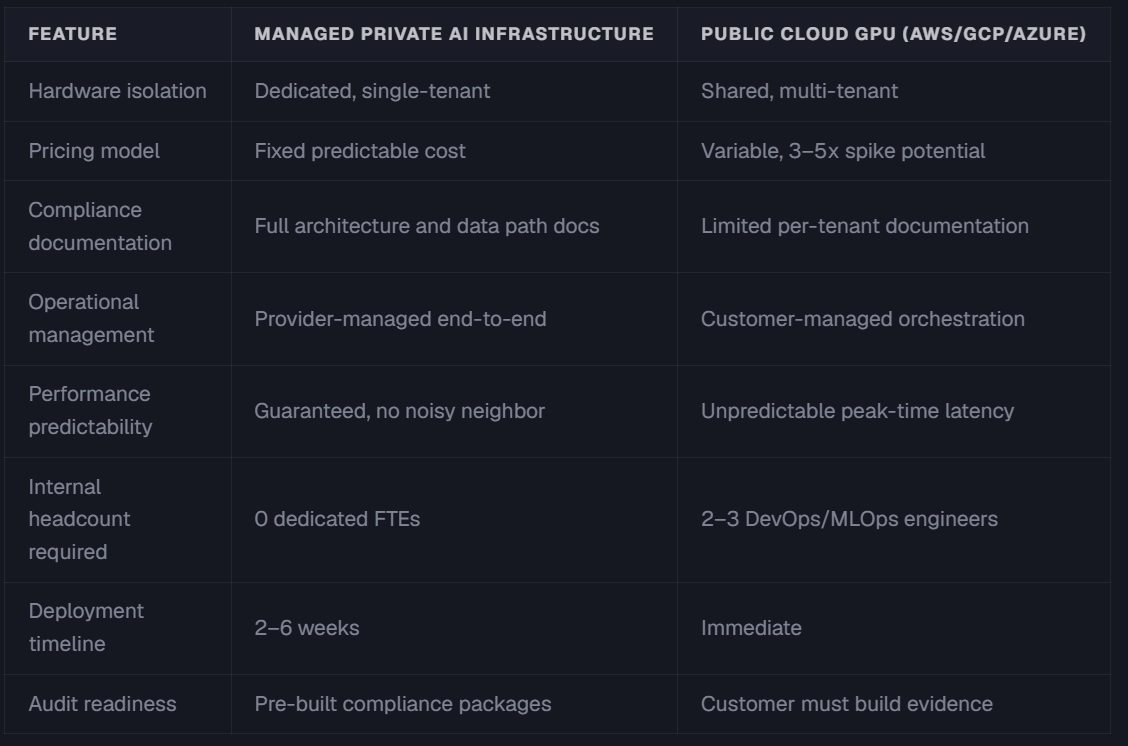
Predictable costs eliminate the 280-320% pricing volatility that public cloud GPU instances experience during peak demand periods. Organizations can budget for AI infrastructure with confidence rather than absorbing spikes that 3-5x their compute costs.
Provisioning times drop from weeks to days. Public cloud GPU availability varies by region and demand. Private infrastructure is provisioned and ready when the organization needs it.
Audit readiness improves because every compute cycle occurs on documented hardware. Compliance teams can produce evidence of data processing boundaries without relying on third-party platform logs.
Performance is consistent because no noisy-neighbor workloads compete for GPU memory or compute cycles. Organizations get the full performance of their GPU hardware at all times.
Data sovereignty is maintained because data never leaves the organization's controlled infrastructure. This satisfies residency requirements that public cloud cannot guarantee.
Challenges and Limitations of Private AI Infrastructure
Private AI infrastructure requires upfront planning that public cloud does not. Organizations must forecast their GPU requirements, which AI teams often struggle to do accurately. Deploying 8 GPUs when the workload needs 16 creates a bottleneck. Deploying 16 when 8 suffice wastes capital.
Hardware refresh cycles create a planning obligation. GPU generations advance every 18-24 months. Organizations using private infrastructure must plan for hardware upgrades rather than relying on the cloud provider to refresh infrastructure automatically.
Internal team management of private GPU infrastructure creates operational burden. Recruiting GPU infrastructure engineers takes 18-24 months. Retaining them requires salary premiums of 40% or more over standard infrastructure roles. 24/7 monitoring requirements add staff or force overtime.
These challenges are why many organizations choose managed private AI infrastructure providers rather than building internal capabilities.
Real-World Use Cases for Private AI Infrastructure
Healthcare organizations running clinical decision support models on PHI cannot use public cloud GPU environments without documented hardware isolation. A multi-site health system deploying ambient documentation tools needs HIPAA-compliant infrastructure with BAA execution and direct fiber connectivity to hospital networks and EHR systems. Pre-built compliance documentation accelerates internal IT security review by weeks.
Financial services firms building fraud detection models require SOC 2 Type II compliance with documented data residency controls. A regional bank running risk scoring models cannot expose financial data to shared GPU environments. Dedicated infrastructure with fixed pricing eliminates the compliance gap and the budget volatility that makes cloud GPU spending unpredictable.
University research labs receiving federal grant funding must document controlled compute environments. NIH and DoD grants require verifiable data processing boundaries. Private GPU clusters deployed in secure, compliant environments satisfy these requirements while supporting the high-performance compute demands of research workloads.
OneSource Cloud provides dedicated GPU clusters for these use cases through end-to-end architecture design and fully managed operations.
Best Practices for Moving AI Workloads to Private Infrastructure
- Complete a workload forecasting exercise before selecting infrastructure. Document current GPU usage patterns, expected growth over 12-18 months, and the performance characteristics your models require. This prevents overprovisioning or underprovisioning.
- Identify compliance requirements by regulation. HIPAA requires specific documentation including BAAs. SOC 2 requires specific control evidence. Government contracts require specific data residency documentation. Each requirement shapes infrastructure architecture differently.
- Evaluate whether internal management or managed services makes financial sense. Calculate the cost of recruiting, hiring, and retaining GPU infrastructure specialists against managed service pricing. At 8-16 GPUs, managed services often become the lower-cost option.
- Design for hardware refresh from the start. Plan for GPU generation upgrades every 18-24 months. Choose a provider that handles hardware lifecycle management as part of the service.
- Build flexibility into the deployment architecture. Workloads change. Infrastructure should accommodate growth without requiring a complete rebuild.
Private AI Infrastructure vs Public Cloud GPU: Feature Comparison
Industry Statistics and Research
- According to Gartner, by 2026, 60% of AI workloads in regulated industries will shift from public cloud to dedicated infrastructure due to compliance requirements.
- According to IDC, organizations managing their own GPU infrastructure spend an average of 30% more on operations compared to using managed private infrastructure services.
- According to McKinsey, the demand for GPU compute in healthcare AI applications is growing at 42% annually, with compliance infrastructure as the primary barrier to adoption.
- According to NVIDIA, enterprise AI workloads require dedicated GPU infrastructure to achieve consistent performance, as shared environments experience up to 40% performance variance.
- According to Forrester, 67% of compliance officers in financial services cite shared infrastructure concerns as the primary reason for blocking public cloud GPU adoption for regulated workloads.
Expert Insight
The compliance boundary argument is not theoretical. In practice, the difference between hypervisor isolation and physical isolation shows up during audits. Cloud providers produce logs saying data was processed on a specific instance type. They cannot produce logs saying data was processed on a specific GPU that no other tenant accessed. Every enterprise CISO I have worked with understands this distinction immediately. That is why they block projects. Private infrastructure closes this gap by making the hardware documentation as complete as the software documentation.
Frequently Asked Questions
What is private AI infrastructure for regulated industries?
Private AI infrastructure refers to dedicated GPU clusters deployed in physically isolated environments where all data processing occurs on hardware controlled exclusively by one organization. This architecture satisfies HIPAA, SOC 2 Type II, and other compliance requirements by providing verifiable hardware-level isolation.
How much does private AI infrastructure cost?
Private AI infrastructure costs vary by GPU cluster size, data center requirements, and management level. Fixed pricing eliminates the 280-320% volatility of public cloud GPU pricing. Managed services often become cost-effective compared to internal teams at 8-16 GPU clusters.
Is private AI infrastructure more secure than public cloud?
Private AI infrastructure provides verifiable hardware isolation that public cloud GPU environments cannot match. For regulated workloads requiring documented evidence that data never touches shared hardware, private infrastructure is the only option that satisfies compliance requirements.
How long does private AI infrastructure deployment take?
Deployment timelines range from days to weeks depending on infrastructure complexity, data center availability, and compliance documentation requirements. Pre-configured deployments typically complete faster than custom architecture designs.
Who uses private AI infrastructure?
Healthcare organizations processing PHI, financial services firms handling sensitive financial data, government contractors managing controlled unclassified information, and university research labs operating under federal grant requirements all use private AI infrastructure for regulated workloads.
What are the alternatives to private AI infrastructure?
Alternatives include public cloud GPU instances for non-sensitive workloads, on-premises GPU deployment for organizations with internal infrastructure teams, and colocation for organizations that own hardware but lack data center facilities. Each alternative has trade-offs in compliance, cost, and operational burden.
Can private AI infrastructure be used for non-regulated workloads?
Yes. Private AI infrastructure supports all AI workloads, not only regulated ones. Organizations often consolidate regulated and non-regulated workloads on private infrastructure for unified management and consistent performance.
How does managed private AI infrastructure reduce operational burden?
Managed private AI infrastructure eliminates the need for organizations to recruit, hire, and retain GPU infrastructure specialists. The provider handles monitoring, hardware replacement, firmware management, and security patching, reducing operational overhead by 40-60% based on customer benchmarks.
Sources
- Gartner — enterprise technology research
- IDC — market intelligence
- McKinsey & Company — business research
- NVIDIA — GPU and AI infrastructure
- Forrester — B2B technology research
Related Resources
- Gartner Research — analyst reports on AI infrastructure
- NVIDIA Technical Documentation — GPU architecture specifications
- McKinsey Digital — enterprise transformation research
- HIPAA Journal — healthcare compliance guidance
- SOC 2 Compliance Resources — audit standards documentation
Ready to Take the Next Step?
Your compliance team cannot accept shared GPU infrastructure for regulated workloads. Private AI infrastructure closes the gap between what your models require and what your compliance framework demands. OneSource Cloud provides dedicated GPU clusters with end-to-end managed operations, eliminating the operational burden while meeting HIPAA, SOC 2 Type II, and government contract requirements.
